National Museum of Anthropology
The Umbrella and Inverted Fountain
A bronze umbrella where water becomes a waterfall.
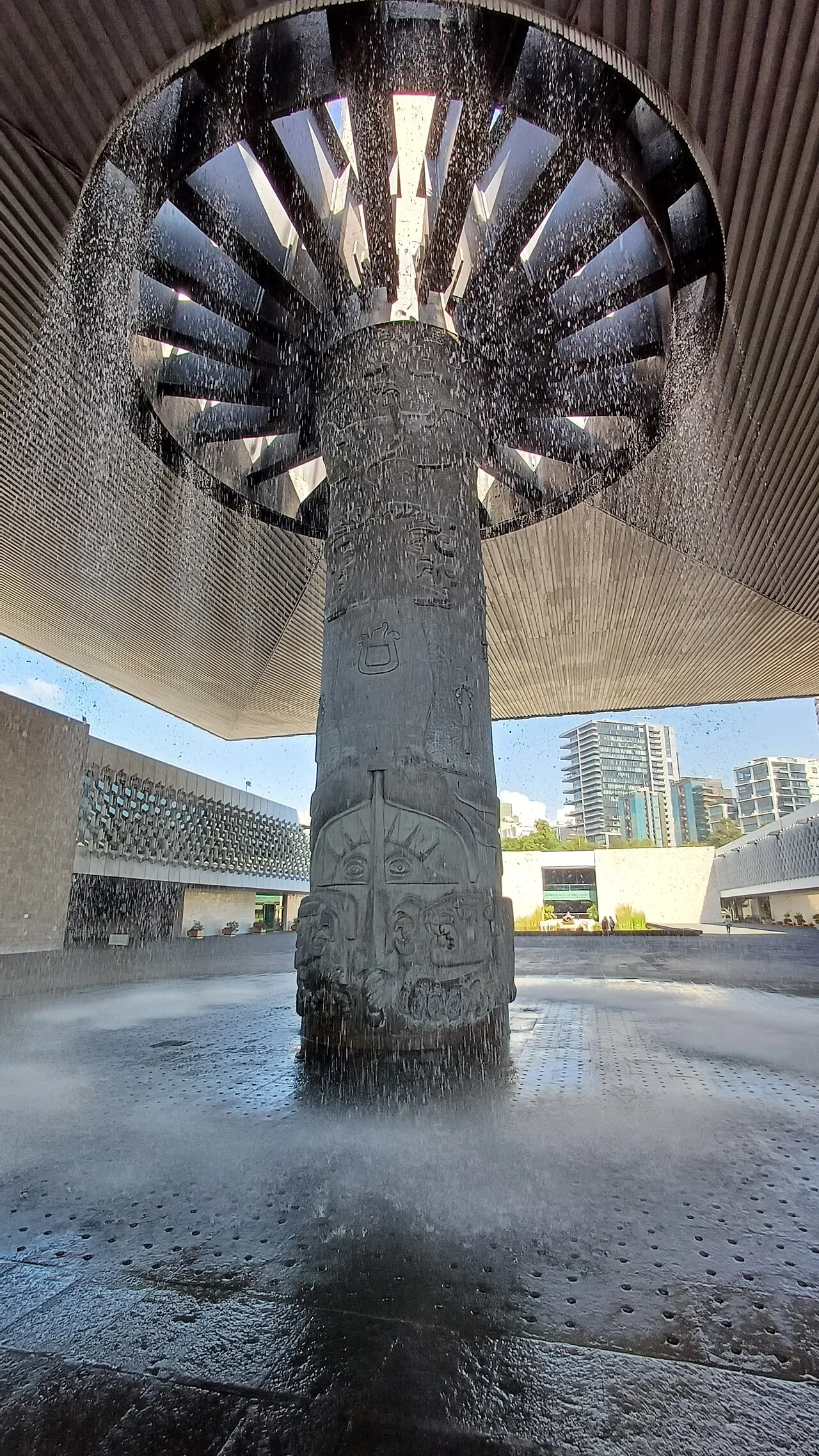
Location: Architecture and Central Courtyard, National Museum of Anthropology.
For the ancient peoples of Mesoamerica, the center of a city was not simply a point on a map: it was the axis of the world, the place where the sky, the earth, and the underworld met. Ramírez Vázquez took up that idea and gave the museum a center that organizes everything. The halls open around the courtyard like the rooms of a house, and in the middle he raised a structure that did not exist in any pre-Hispanic city: a giant roof on a single column.
The technical challenge was enormous. The canopy measures fifty-four by eighty-two meters and is designed to leave the courtyard free of supports, so that air and light keep coming in while the rain does not wet the visitors. That sense of lightness, with so many tons overhead, is part of its magic. In addition, the canopy slopes gently toward the center, so that rainwater runs toward the column instead of pooling. And the inverted fountain is an engineering detail with beauty included: instead of water falling from the sky, it falls from the center of the roof, forming a circular curtain that gives the courtyard its sound.
But the true treasure is the column. The brothers José and Tomás Chávez Morado covered it in bronze with a great relief that sums up the history of Mexico and bears the name “Imagen de México.” Walk around it, because each side reads like a chapter. On one side is the Indigenous world, with its gods and the founding of Tenochtitlan. On another, the arrival of the Europeans and the blending of peoples. On a third side are the struggles for independence, and on the fourth, modern Mexico, with science and the aspiration to peace.
Now think about what it means. This relief is a modern version of what the peoples you will see inside used to do: tell the story of their world in stone and in symbols, so that no one forgets who they are. The Mexica did it in the Teocalli and in the Stone of Tízoc; the Maya, on the lintels of Yaxchilán; the Zapotec, on the stela of Los Danzantes. Here, the language is bronze, but the intention is the same.
A curious fact: although today we see it as the symbol of the museum, the Umbrella was a gamble. A roof of this size, held up by a single column, was a feat of engineering for its time. And notice a delicious paradox: the building dedicated to civilizations that knew neither the arch nor iron debuts here a structure that was only possible with the steel and concrete of the twentieth century. The ancient and the modern shake hands on purpose.
Before moving on, stand in the center, breathe, and listen to the water. That curtain of sound is the perfect transition: in a few steps you will enter a story thousands of years old.
Listen to the full audio guide for National Museum of Anthropology
72-hour pass for US$7, no subscription.