National Museum of Anthropology: audio guide for your visit
Mexico's and Latin America's most important archaeological and ethnographic museum, with 22 halls and more than 130 masterpieces analysed in detail.
72-hour pass for US$7, no subscription. 2 works to listen to for free, no sign-up.
About the museum
The National Museum of Anthropology, in Chapultepec Park, tells the story of the peoples of Mexico before and after the Conquest. Pedro Ramírez Vázquez and his team designed it, it was built in just nineteen months and it opened on 17 September 1964. Its central courtyard, with the famous bronze “umbrella” and its pond, organises the whole visit.
It has twenty-two halls on two floors. The ground floor holds the archaeology, from the first settlers of the Americas to the Mexica, by way of Teotihuacan, the Toltecs, Oaxaca, the Gulf Coast, the Maya, the West and the north of the country. Upstairs is the ethnography: the Indigenous peoples of today, with their languages, textiles and festivals.
It is huge, and it is hard to see everything in a single visit. That is why this guide suggests tours based on the time you have, from the essentials to complete halls, and you can also build your own. The works come in the order you walk, so you never have to retrace your steps.
What to see: The essentials
16 works in about 1 h 10 min, in the order you walk.
- Tláloc Monolith The rain god who arrived in the city with a storm.
- The Umbrella and Inverted Fountain A bronze umbrella where water becomes a waterfall.
- Reconstruction of the Facade of the Temple of Quetzalcóatl Feathered Serpents emerging from the sea where the world began.
- Monumental Sculpture of Chalchiuhtlicue The colossal water goddess who traveled by train and by mule.
- Tepantitla Mural (The Tlalocan) A painted paradise where the water never runs out.
- Disc of Death A skull with red rays that represents the Sun as it dies.
- Atlante of Tula A stone warrior who held up the roof of his temple.
- Coatlicue The mother goddess who gives life and claims it back, made of serpents.
- Head of Coyolxauhqui The defeated moon: a head with bells on its cheeks.
- Tlaltecuhtli The Earth squatting, jaws wide open.
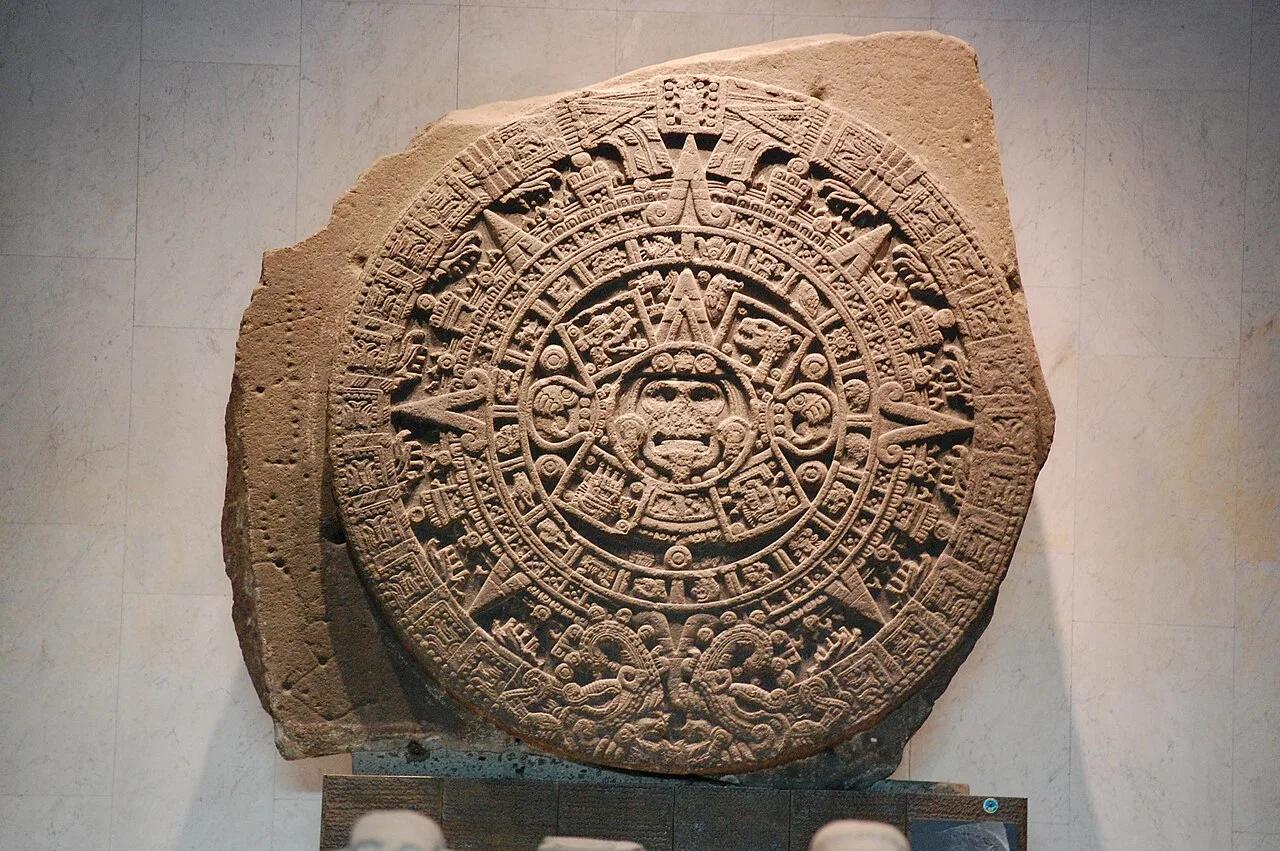
- Sun Stone Mexico’s most famous stone is not a calendar.
- Stela of “Los Danzantes” from Monte Albán They are not dancing: they are defeated chiefs, carved in stone two thousand five hundred years ago.
- Mixtec Gold Pectorals and the Treasure of Tomb 7 The gold of a Mixtec lord, buried in a tomb that was not his own.
- Colossal Head 6 from San Lorenzo A basalt portrait more than three thousand years old: the face of an Olmec king.
- Mask of Pakal A king covered in jade to be reborn as the Maize God (Corn God).
- Crypt and Sarcophagus of Pakal (Recreation) A king’s tomb, recreated at full scale under a red light.
Tours
Pick one for the time you have. The audio guide takes you one stop at a time.
- Lightning visit 40 min · 7 works
Seven unmissable stops in about 40 minutes, all on the ground floor: the Umbrella, Teotihuacan, the Tula Atlantean, the Coatlicue, the Sun Stone, the Olmec colossal head and Pakal’s mask. With the full audio, add about 20 minutes. - The essentials 1 h 10 min · 16 works
The sixteen works you cannot miss, in order across the ground floor: Tlaloc, the Umbrella, Teotihuacan, Tula, the Mexica Hall with the Sun Stone, Oaxaca, the Olmec head and Pakal’s tomb. Ideal for a first visit. With the full audio, add about 40 minutes. - The best of the museum 2 h · 32 works
Thirty-two pieces through the great halls of the ground floor: the grounds, Teotihuacan, the Toltecs, the Mexica with the Sun Stone, Oaxaca, the Gulf Coast, the Maya and West Mexico. For an unhurried visit that misses nothing important. With the full audio, add more than an hour. - The ground floor in depth 3 h · 48 works
The forty-eight key works in every archaeology hall, from human origins and the mammoth to the Sun Stone, the Maya world and northern Mexico. A full museum morning; a break halfway through helps. - The Mexica in depth 45 min · 14 works
The whole Mexica Hall, piece by piece, in fourteen stops: the Coatlicue, Tlaltecuhtli, the Stone of Tizoc, Moctezuma’s headdress, the Tlatelolco model and, at the end, the Sun Stone. All in one hall, with almost no walking. - Central Empires 1 h 5 min · 18 works
The story of Central Mexico’s three great capitals in eighteen consecutive stops: the murals and gods of Teotihuacan, the Atlanteans of Tula and the monoliths of Tenochtitlan, ending at the Sun Stone. - The Maya, then and now 1 h · 17 works
Twelve stops in the Maya Hall, with Pakal’s mask and crypt, Yaxchilan, Calakmul, Jaina and the Bonampak temple, and five in the Maya Peoples hall right upstairs, with Leonora Carrington’s mural and the clothing of Chiapas and Yucatán. - For visiting with kids 1 h · 13 works
Thirteen stops to amaze the whole family on the ground floor: the Umbrella waterfall, Lucy, the mammoth, the acrobat, the grasshopper, the headdress, the Sun Stone, a giant Olmec head, Pakal’s mask and the Colima dogs. With children, leave extra time for breaks. - Tombs and treasures 1 h · 13 works
Thirteen stops on death and the afterlife on the ground floor: a prehistoric burial, Tlaltecuhtli and the Sun Stone, Tomb 104 at Monte Albán, the gold and turquoise skull of Tomb 7, Pakal’s crypt, a shaft tomb and the finds from the Candelaria Cave. - Peoples of today 1 h 50 min · 22 works
Starts on the ground floor at the Sun Stone, then goes upstairs for the twenty-one most striking pieces on the upper floor: Wixárika beadwork, Purépecha dances, the voladores, Oaxaca black clay and Maya and Nahua textiles. - The whole ground floor 7 h 30 min · 127 works
All one hundred twenty-seven archaeological works on the ground floor, hall by hall, from human origins to Tenochtitlan, the Maya and the northern desert. It is more than a day of museum: do it over several visits; the app saves your progress. - The whole upper floor 3 h 30 min · 52 works
All fifty-one stops on today’s Indigenous peoples, hall by hall on the upper floor, starting at the Sun Stone on the ground floor.
Rooms
- Architecture and Central Courtyard A museum that begins before the first hall.
- Introduction to Anthropology Before cities and gods, there was the question of who we are.
- Peopling of the Americas The first Americans crossed a world of ice.
- Preclassic in the Central Highlands Here, the seed becomes a village.
- Teotihuacán The city where, according to the Mexica, men become gods.
- The Toltecs and Their Era After the city of the gods comes the city of the warriors.
- Mexica Tenochtitlan, the city raised upon the water to feed the Sun.
- Oaxaca Two mountain peoples who turned death into art.
- Cultures of the Gulf Coast Jungles, rivers and rubber: the coast where the first great culture was born.
- Maya Jade kings, scribes, and astronomers: the Maya world, alive to this day.
- Cultures of Western Mexico Deep tombs, clay dogs, and the masters of copper.
- Cultures of Northern Mexico Desert, frontier, and turquoise: the north that lived another way.
- Indigenous Peoples A floor for looking at those who are still here: sixty-eight peoples and their languages.
- Gran Nayar Sacred sierras where the deer, the fire, and the maize form a single story.
- Purépecha Hands that shape wood, copper and wool beside Lake Pátzcuaro.
- Otopame Peoples Heirs of the maguey: textiles, fibers, and altars of the peoples of the highlands.
- Sierra de Puebla Feathers, flight, and mist: the Puebla highlands celebrate with the sky.
- Oaxaca The state of a thousand colors: textiles, clay, and festivals that never stop.
- Huastecs and Totonacs Vanilla, violins, and altars of flowers on the plains of the Gulf.
- Maya Peoples The Maya today: wool in the mountains, smoke in the jungle, flowers in Yucatán.
- Northwest From the desert to the sierra: peoples who dance, weave, and carve their freedom.
- Nahua Peoples The language of the Mexica is still alive: in embroidery, painted paper and altars of corn.
Before you go
Getting there
The museum is in Chapultepec Park, on Paseo de la Reforma, and the Metro is the easiest way.
- Auditorio station (Line 7): about 10 minutes on foot.
- Chapultepec station (Line 1): about 20 minutes on foot across the park.
- By car: there is parking next to the museum, but it fills up on Sundays.
You enter through the big courtyard with the umbrella-shaped fountain. If you see it, you are in the right place.
Hours and tickets
Open Tuesday to Sunday, 9:00 to 18:00. Closed on Mondays.
On Sundays admission is free for Mexican nationals and foreign residents. Children under 13, seniors with a card, students and teachers, and people with disabilities are also admitted free, under the current conditions. On other days there is a general ticket, with one rate for Mexicans and residents and a higher one for foreign visitors.
Prices change every year, so check the museum's official website before you go.
When to go
The quietest time is a Tuesday, Wednesday or Thursday at 9:00. School groups and tours arrive around 10:00.
Sunday admission is free and the museum gets crowded. If you go that day, arrive at opening and head to the most famous rooms first, before they fill up.
A full visit takes half a day. One of the short routes in the app, from 40 minutes, covers the essentials.
What to bring and what to leave
Bring headphones and a charged phone. The rooms are strongly air-conditioned, so a light jacket helps.
Download the audio before you go in, so you do not depend on a signal inside the museum.
There is a cloakroom near the entrance. Leave large backpacks, umbrellas and bulky items there.
Facilities
There are restrooms in several parts of the museum, a café, a bookshop with publications and reproductions, and a cloakroom. If you prefer a calmer meal, Chapultepec Park has food stalls and small restaurants a few minutes away on foot.
Accessibility
This is one of the easier museums in the city to get around: there are ramps and lifts between the ground and upper floors, and wheelchairs can be borrowed. Ask at the entrance.
Distances between rooms are long, so plan some breaks. If mobility is limited, choose a short route and stay on one floor.
Site rules
You can take photos without flash for personal use. Tripods are not allowed. Some rooms or pieces have their own signs, and if one says no photography, respect it.
Do not bring food or drink into the rooms, and do not touch the pieces or the display cases. Rules can change; the gallery staff will tell you if you are unsure.
Tips
Do not try to see it all. Pick three rooms that catch your eye, give them time and leave the rest for another visit.
- The ground floor is archaeology: from the first settlers to the Mexica.
- The upper floor is ethnography: Indigenous peoples today.
- When you finish, sit for a while by the courtyard fountain. You have earned it.
- Two hours covers the essentials. If you like to linger, set aside four.
72-hour pass for US$7, no subscription. 2 works to listen to for free, no sign-up.