Templo Mayor and Metropolitan Cathedral
The Coyolxauhqui Monolith in the Museum
The original stone you saw where it was found, now up close.
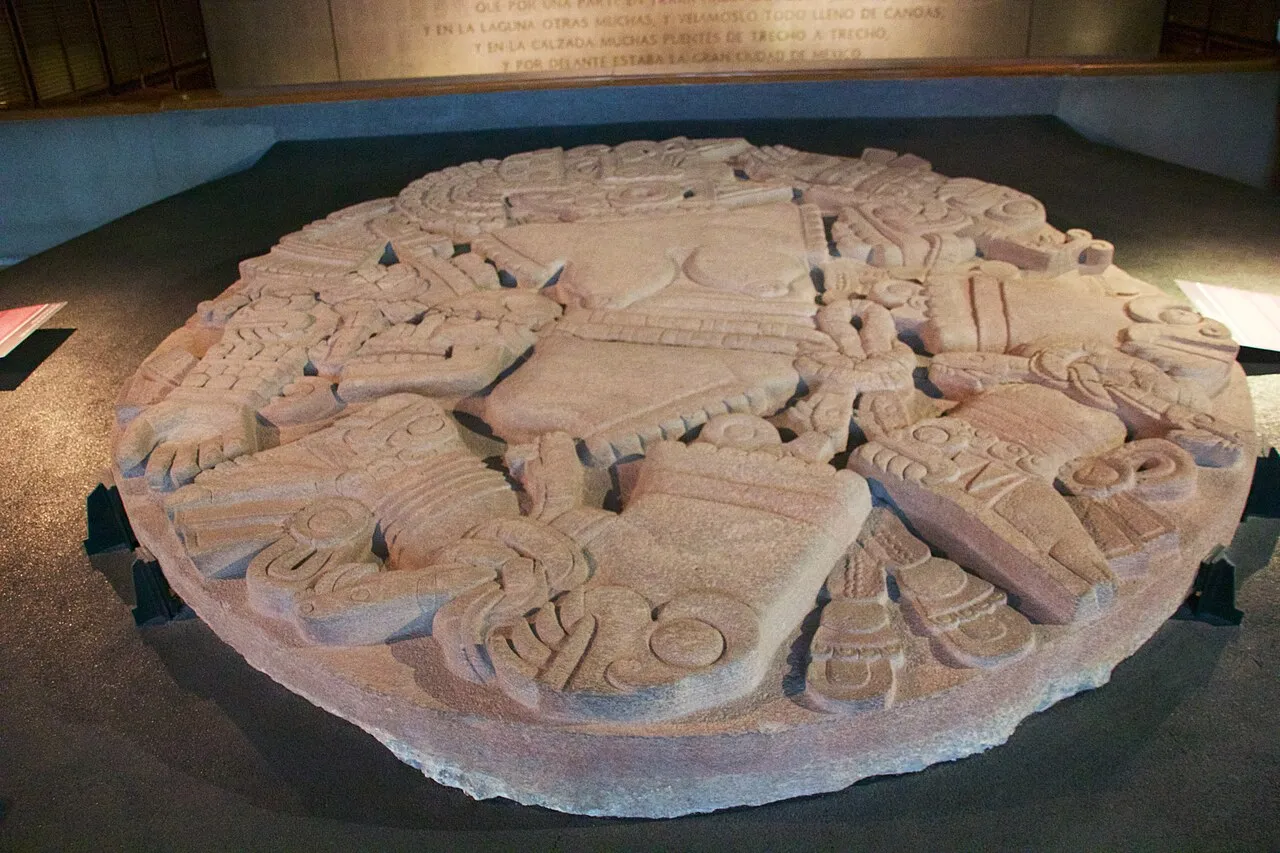
Location: The Templo Mayor Museum, Templo Mayor and Metropolitan Cathedral.
This is the most important piece in the museum, and probably the one the public knows best. It is the Coyolxauhqui monolith, the disk that appeared in nineteen seventy-eight and that gave rise to the entire project.
First, the numbers, according to the INAH. The disk measures three meters twenty-five centimeters in diameter and weighs almost eight tons. In other words, it is an enormous stone, and moving a piece like this was a considerable task for the team that recovered it. It was found on the twenty-first of February, nineteen seventy-eight, at the foot of the temple’s south staircase, where you were a little while ago.
Now, the scene. The carved figure is a woman, and her body is dismembered: the head, the arms and the legs appear separated from the torso, but arranged within the circle. It is a composition that forces the eye to travel over each part, one by one, until the body is complete. The relief is worked with great care, and this shows in the adornments, in the details of the clothing and in the forms of the body.
The name, according to the INAH, means she who has facial paint of bells. In Mexica tradition, Coyolxauhqui is the sister of Huitzilopochtli. When he was born, she led her brothers, the Centzonhuitznahua, in an attack against their mother. Huitzilopochtli emerged armed, defeated her, and her body fell down the slope of the Coatépetl.
That is why the stone lay at the foot of the sanctuary’s staircase. The scene on the stone repeated, on the ground, what the myth told on the mountain. Whoever saw it understood the message without needing words: the god triumphs over his enemies.
There is something else worth knowing. Hall eight of the museum, the last one, displays fragments of another Coyolxauhqui, also monumental, that was destroyed by the Spanish. That other piece does not survive complete, and that says it all. This makes the monolith in front of you even more valuable, because it was saved from destruction.
Notice, too, how the piece is presented. In the museum you can see it from the front. In the temple, by contrast, it lay at the foot of the staircase, in plain view of anyone approaching the sanctuary. Imagine how it would have looked there, in the light of day. If you remember Tlaltecuhtli, which preserves traces of color, you will understand that these sculptures may have been painted, and that it is worth imagining them in full color.
Take your time to walk around it and look at it from different sides. First look for the head, then the arms and the legs, and finally the adornments. This piece deserves a few minutes of your attention, because it sums up in a single object the myth, the archaeology and the history of the city. Without it, you would probably not be in this museum today, and the center of the city would look different.
Listen to the full audio guide for Templo Mayor and Metropolitan Cathedral
72-hour pass for US$6, no subscription.