Templo Mayor and Metropolitan Cathedral
The Plaza and the Sacred Precinct of Tenochtitlan
This entire downtown area is built on a lake city that had a precinct with as many as seventy-eight temples.
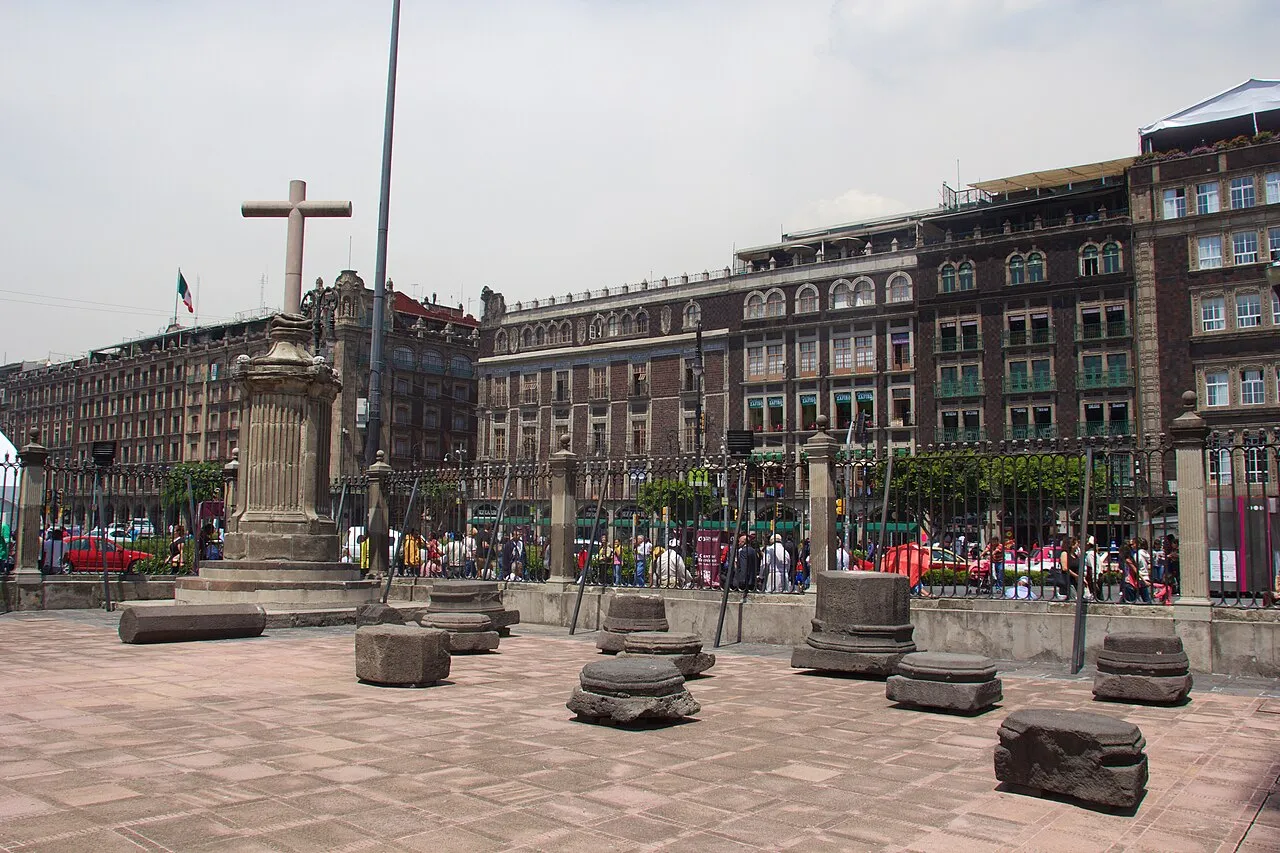
Location: The Plaza and the Facade of the Cathedral, Templo Mayor and Metropolitan Cathedral.
This guide runs from the Spanish city to the Mexica city, and it helps to begin by understanding what lies beneath your feet.
According to tradition, the Mexica settled on a small island in Lake Texcoco around thirteen twenty-five. The land was scarce, so they kept expanding it. With landfill, wooden piles, canals, dikes, and bridges, they won land from the lake until they reached about thirteen and a half square kilometers. That city was called México-Tenochtitlan. It had eleven rulers, and its fall came in fifteen twenty-one, after the war with the Spaniards and their Indigenous allies.
At the center of the city there was a set-apart space, the Sacred Precinct. There stood the Templo Mayor, which the Mexica called Huey Teocalli, the great house of the god. They considered it the navel of the universe. According to the chronicles from colonial New Spain, the precinct came to have as many as seventy-eight buildings, including temples, altars, platforms, schools, and ball courts. Not just anyone could enter. Priests, warriors, rulers, and students of the Calmécac, the school for the children of nobles, had permanent access. Ordinary people entered during the festivals.
When the city fell, Hernán Cortés decided that the capital of New Spain would stand right there. The Spaniards tore down the Templo Mayor, and its stones were reused as foundations for viceregal buildings. That is a good way to see what happened. A new city was not raised in an empty place, but on top of another one that was still standing. The Cathedral in front of you is part of that story. It was built on a portion of the grounds of the old precinct, and that is why its soft ground and its foundations have caused so many problems.
For centuries, little was known about the Templo Mayor. There were isolated finds in seventeen ninety, and Manuel Gamio uncovered a corner of the building in nineteen thirteen. But the great discovery came in nineteen seventy-eight, when a circular stone appeared by chance. We will speak of it later.
Here is how this tour is organized. First you will walk around the outside of the Cathedral, and then you will go in, if it is open. After that you will go to the archaeological zone of the Templo Mayor and its museum. The Cathedral is usually free to enter, although some areas ask for a fee or a donation. The archaeological zone and the museum share a single ticket, and it is wise to check the current days and hours before you go. If today you only want to see part of it, choose one of the shorter routes.
Now look around. The Cathedral closes off the north side of the plaza. The ruins of the Templo Mayor cannot be seen from here: they lie behind the Cathedral, to the east, a few hundred meters away. That short distance crosses two worlds. Begin with the one you see in front of you, and take along the question of how many layers can fit in a single place.
Listen to the full audio guide for Templo Mayor and Metropolitan Cathedral
72-hour pass for US$6, no subscription.