Chichén Itzá Archaeological Zone
The Great Ball Court
The largest known ball court in Mesoamerica: more than one hundred sixty meters long.
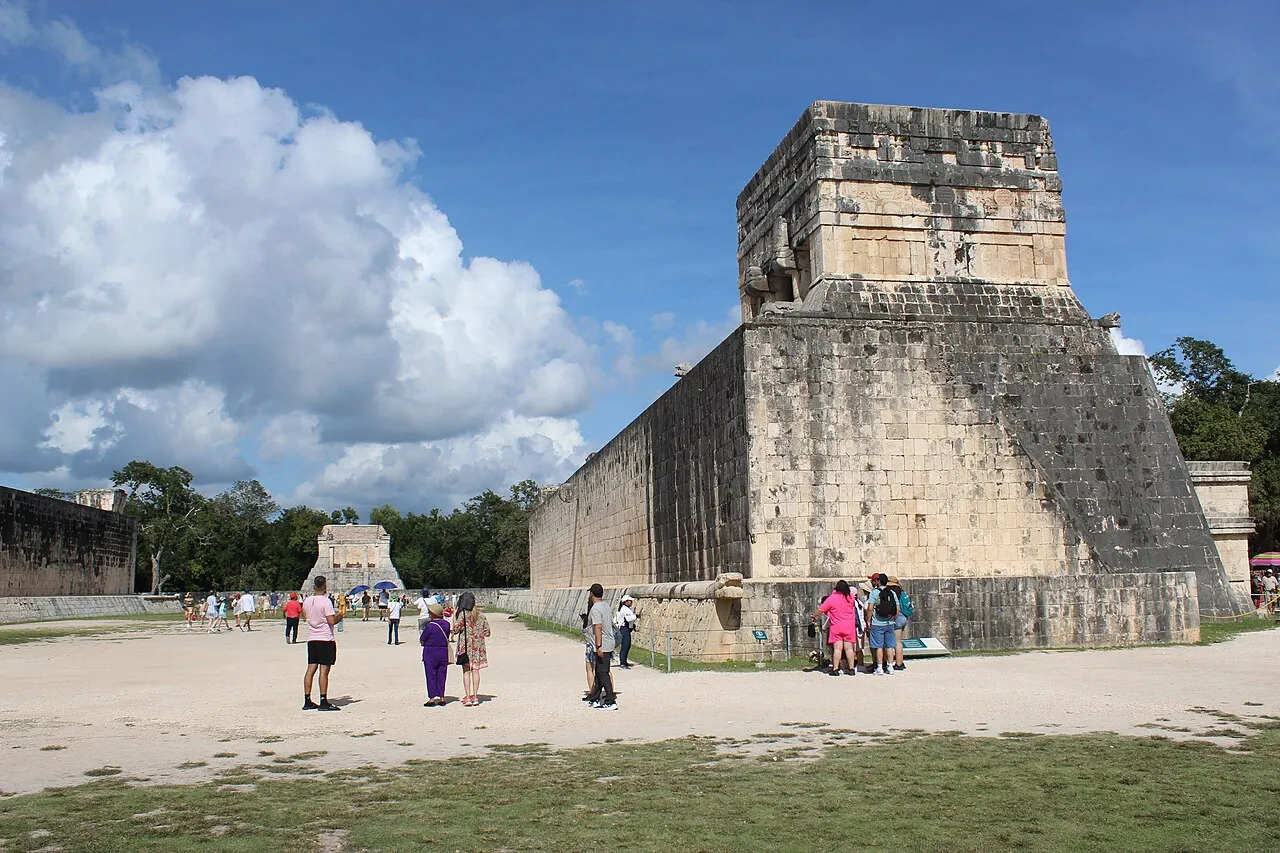
Location: The Great Ball Court Complex, Chichén Itzá Archaeological Zone.
You are standing at the largest ball court known in Mesoamerica. You understand why when you see how far it stretches.
The INAH describes it as more than one hundred sixty-eight meters long and seventy wide. Another, more technical description gives a total length of one hundred fifty-two and a half meters, and a width of about seventy-one. The court proper measures about thirty meters wide, and each side wall about ninety-six and a half meters. The measurements vary depending on what is being measured. What is certain is that it is enormous.
It was built around the year nine hundred, in the Terminal Classic period. It was a time when several Maya cities in the north moved from the rule of a single governor to a council of nobles. It is the main one of the thirteen ball courts that have been documented at Chichén Itzá. An inscription on a circular stone gives the date of November seventeenth of the year eight hundred sixty-four, according to a reading by the researcher Ruth Krochock, and some have taken it as the dedication of the court. However, some studies suggest that the court was built around the year nine hundred, perhaps over an earlier one.
The complex has four large structures. To the east and the west there are two long platforms with benches, which carry the reliefs. At the back of those platforms, stairways rise to five small temples and to the Upper Temple of the Jaguars. And at the ends of the court there are two more temples, the North and the South.
Look at the rings. They are on the side walls, very high above the floor. The INAH records one ring at about eight meters. They are carved with two feathered rattlesnakes that intertwine around six concentric circles. The INAH recalls that it was believed that the players tried to pass the rubber ball through the hoop, and that the image could symbolize a portal to the underworld and a cycle of death and rebirth. A carved ring is on display today in the Great Museum of Chichén Itzá, inside the archaeological zone.
There is an important idea behind all this. The specialist Linda Schele maintained that the ball game was not a sport, but a serious matter, tied to the continuity of the state and to contact with the other world. That is why the reliefs on the benches speak of sacrifice, and the rings, of the underworld.
There is still one more piece needed to understand the place. Archaeologists excavated a section of about ninety meters of the wall that surrounded the ceremonial center, right between this court and the western pedestrian entrance. One hypothesis proposes that the Ball Court was raised after that wall and after the Lower Temple of the Jaguars.
When you finish, continue to the next stop on your tour. The benches with reliefs are at the base of the walls, at floor level.
Listen to the full audio guide for Chichén Itzá Archaeological Zone
72-hour pass for US$14, no subscription.