Teotihuacan Archaeological Zone
Teotihuacán at a Glance
A city laid out with a ruler and the sky, some two thousand years ago.
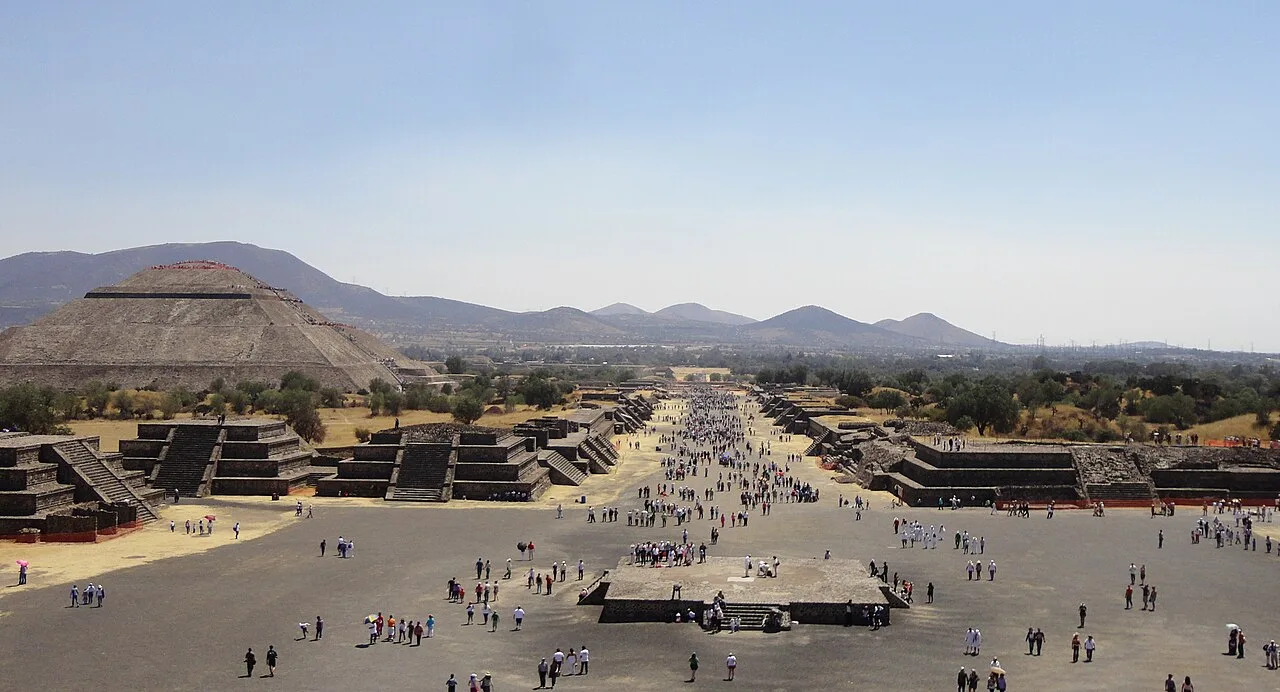
Location: Teotihuacán at a Glance, Teotihuacan Archaeological Zone.
Almost none of the names you will hear today belonged to the people who raised these stones. Teotihuacán is the name the Mexica gave it centuries later, when the city was already empty. The Mexica also christened the central avenue the Avenue of the Dead, because they believed the mounds along its sides were tombs of ancient kings. They were not: they are temples and palaces. In Maya inscriptions, the city appears under another name, Puh, which means Place of Rushes. What its own inhabitants called it remains a mystery.
Why did a city of this scale grow here? Because the valley had almost everything. There were springs, fertile land, and clay for building. Very close by were the obsidian mines of Pachuca, the volcanic glass from which the finest blades and arrowheads in Mesoamerica were made. That obsidian was sold as far as Monte Albán and Tikal, and the state oversaw its production and trade. Some researchers think that families displaced by the volcanic eruptions in the southern Basin of Mexico also arrived. The exact order of those events is still debated.
The city planners laid out the city as a giant grid. The Avenue of the Dead runs from south to north, and two great avenues cross it at right angles. But if you carried a compass, you would notice something strange: the entire city is turned about fifteen degrees east of true north. The central part follows the orientation of the Pyramid of the Sun. Its facade faces the place where the Sun sets at the end of April and in mid-August. Between those dates, two hundred sixty days are counted, the length of the ritual calendar.
The story you are about to walk through has four great moments. Between the first and second centuries, the pyramids of the Sun and the Moon are raised. Around the year two hundred, the Citadel is built with its great temple. From the fourth century onward comes the peak: it is estimated that there were some two thousand apartment compounds, each with dozens of people. There were also neighborhoods of artisans and people who came from Oaxaca, Veracruz, and the Maya region.
The fourth moment is the end. Around the year five hundred fifty, a fire devastated the elite buildings along the Avenue. There is no trace of a foreign invasion. Among the explanations mentioned are droughts, famine, and internal revolts. The city did not disappear overnight: it emptied little by little. Almost everything we know today has been reconstructed by archaeologists over more than a century, and open questions remain.
This guide moves from south to north, just like the Avenue. Some stops show you what is in plain view. Others work like X-rays: they tell you what lies hidden beneath your feet, such as tunnels and sealed offerings.
Listen to the full audio guide for Teotihuacan Archaeological Zone
72-hour pass for US$10, no subscription.