Teotihuacan Archaeological Zone: audio guide for your visit
The legendary 'City of the Gods', a ceremonial centre and one of the largest pre-Hispanic cities, home to the Pyramid of the Sun and the Pyramid of the Moon.
72-hour pass for US$10, no subscription. 2 stops to listen to for free, no sign-up.
About the site
Teotihuacan, about fifty kilometres from Mexico City, was one of the largest cities in the world around the year 450 CE. When the Mexica reached its ruins centuries later, they thought only the gods could have built it, and so they called it “the place where men become gods”. Today it is a UNESCO World Heritage Site.
Everything is organised around the Avenue of the Dead, the great axis that crosses the city. Along it stand the Pyramids of the Sun and the Moon, the Ciudadela with the Temple of Quetzalcoatl, the palaces with their murals and the neighbourhoods where the artisans lived.
It is an outdoor visit, long and with little shade, so the guide offers two routes: an express one with the essential places and a complete one, from Gate 1 to the exit, with every stop in the order you walk them.
What to see: Express route: Teotihuacan essentials
12 stops in about 3 h, in the order you walk.
- Teotihuacán at a Glance A city laid out with a ruler and the sky, some two thousand years ago.
- The Ciudadela and the Great Plaza The Spaniards thought it was a fortress. It was the heart of power.
- Temple of the Feathered Serpent More than one hundred thirty people were buried beneath its foundations to consecrate this temple.
- Walking the Avenue of the Dead An avenue forty meters wide that was the axis of the entire city.
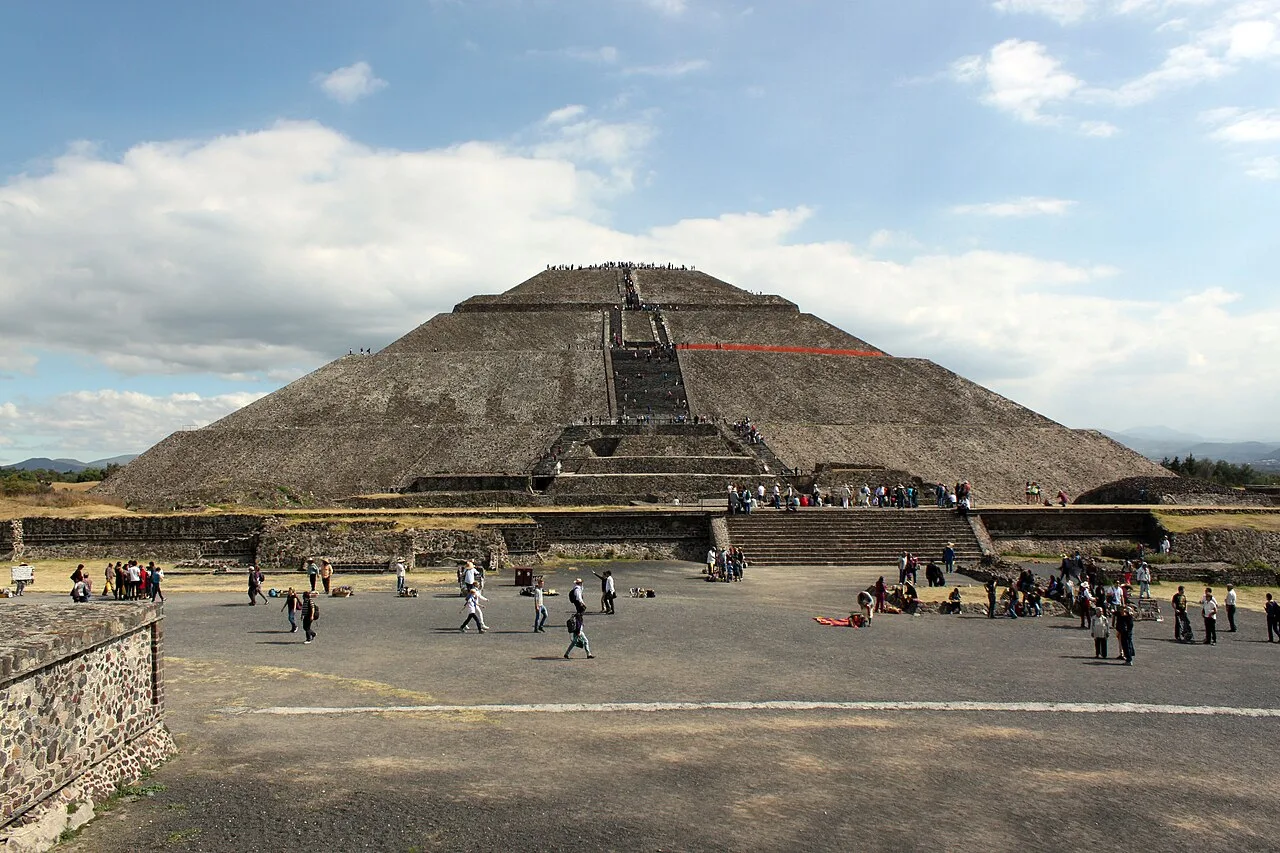
- Pyramid of the Sun A mountain made by hand: more than a million cubic meters of earth raised in a single stage.
- Teotihuacán Culture Museum (Site Museum) A pause to see the city in miniature and the objects that made it possible.
- The Puma Mural A painted feline prowls along a wall, reminding us that the city was once full of color.
- Plaza of the Moon and the Thirteen Altars A great plaza where pits, green stones, and secrets beneath the floor are still being uncovered.
- Pyramid of the Moon Seven pyramids, one inside another, and beneath them pumas, eagles, and people buried as offerings.
- Palace of Quetzalpapálotl A courtyard of carved pillars where the eyes once had obsidian pupils, and perhaps these are not butterflies at all.
- The End of Teotihuacán The city burned, but no one knows for certain why.
- Teotihuacán After Teotihuacán By the time the Mexica arrived, the city was already a sacred ruin.
Tours
Pick one for the time you have. The audio guide takes you one stop at a time.
- Short walk: Sun and Moon 1 h 25 min · 9 stops
Nine stops along the most spectacular stretch: the Pyramid of the Sun, the Puma Mural, the Plaza and Pyramid of the Moon, and the palaces of Quetzalpapalotl, the Jaguars and the Feathered Conches. Enter through Gate 2 and leave through Gate 3; it is about 2 km (1.2 miles) on foot. A good choice with children, older visitors or under the midday sun. - Express route: Teotihuacan essentials 3 h · 12 stops
Twelve stops covering the great monuments from south to north: the Ciudadela and the Temple of the Feathered Serpent, the Avenue of the Dead, the Pyramid of the Sun, the Site Museum, the Puma Mural, the Pyramid of the Moon and the Palace of Quetzalpapalotl. Enter through Gate 1 and leave through Gate 3; it is about 4 km (2.5 miles) on foot. If your car is at Gate 1, add about 35 minutes to walk back. - The southern half: Ciudadela, Avenue and Sun 3 h 15 min · 15 stops
Fifteen stops to explore the southern half of the city in depth without reaching the Moon: the Ciudadela, the Feathered Serpent, the sealed tunnel, the Great Compound, the superimposed buildings, the Mica Floor, the Pyramid of the Sun and the Site Museum. Enter through Gate 1 and finish at the museum, next to Gate 5; it is about 4.5 km (2.8 miles) on foot. - Murals and palaces 2 h 30 min · 11 stops
Eleven stops to see the city’s original colours: the blue jaguar of the Sun Complex, the Puma Mural, the palaces of Quetzalpapalotl, the Jaguars and the Feathered Conches, the Murals Museum and the Tlalocan of Tepantitla. Enter through Gate 2 and finish at Tepantitla, east of the Pyramid of the Sun; it is about 4 km (2.5 miles) on foot. - How people lived: western neighbourhoods 1 h 20 min · 5 stops
Five stops outside the main area, in the compounds where families lived: Zacuala and Yayahuala, Tetitla with its jade murals and Atetelco with its warrior coyotes, plus two stories for the walk back. Starts and ends at Gate 1; it is about 3 km (1.9 miles) on foot. - Complete route: the whole metropolis 7 h 30 min · 33 stops
All thirty-three stops in order: the whole Avenue of the Dead, both pyramids, the palaces, both museums and the eastern and western outer circuits. It is a full day and about 12 km (7.5 miles) on foot, from Gate 1 back to Gate 1; if you can, drive between the eastern and western circuits.
Zones
- Teotihuacán at a Glance A city laid out with a ruler and with the sky.
- The Ciudadela and the City Center Where power, faith, and the marketplace came together.
- The Avenue of the Dead An avenue designed to trick the eyes and command every step.
- The Sun Complex The city’s largest mountain, its sacred cave, and its treasures.
- Between the Sun and the Moon The corridor of palaces where the fate of the metropolis was decided.
- The Moon Complex Thirteen altars, a sacred mountain, and the most beautiful palace in the city.
- The Eastern Circuit The vivid color of Teotihuacán, its painted paradise, and the round houses.
- Palaces and Neighborhoods of the West Life behind the walls: families, jaguars, warriors, and Zapotecs.
- The End and the Memory Why the heart of the city burned, and how it became legend.
Before you go
Getting there
Teotihuacan is about 50 km northeast of Mexico City, a trip of one to one and a half hours.
- By bus: they leave from the Terminal Central de Autobuses del Norte (Metro Autobuses del Norte, Line 5), roughly every 20 to 30 minutes. Ask for a ticket to «Pirámides» and get off at Gate 1 or Gate 2.
- By car: take the México–Pirámides highway. There are car parks at several gates, and they fill up early at weekends.
- By tour: many include transport and a guide, but they leave you little time.
The site has five gates. Gate 1 is next to the Ciudadela, at the southern end of the Avenue of the Dead.
Hours and tickets
The site is open every day, normally from 9:00 to 17:00, with last entry around 16:30. Hours change on special dates, such as the spring equinox, when it opens earlier.
Tickets are sold at the ticket office and on the INAH website. On Sundays admission is free for Mexican nationals and foreign residents, but it gets very crowded. Some museums inside the site may be closed, so check before you go.
Prices change every year: check the official site.
When to go
On a weekday at 9:00. Tour groups arrive mid-morning and from noon the sun is fierce, especially in March, April and May.
In the rainy season (June to September) it almost always rains in the afternoon: go early and bring a rain jacket.
Avoid the spring equinox (around 20 and 21 March): thousands of people arrive dressed in white and the visit changes completely.
To walk the Avenue of the Dead at an easy pace, allow three to four hours.
What to bring
The essentials: plenty of water, a hat, sunscreen and sunglasses. The site is above 2,200 metres and has almost no shade.
Comfortable closed shoes: the ground is stone and dirt, with uneven stretches.
You can bring a small backpack with fruit or a snack. Leave speakers, alcohol and bulky gear at home, as they are not allowed.
Download the audio before you leave the city.
Facilities
There are restrooms near the gates but almost none along the Avenue, so use them before you start. Next to the gates you will find stalls selling food, water and crafts, and several restaurants nearby, including one inside a cave near Gate 5.
Licensed guides also offer their services at the gates. If you hire one, ask to see the licence and agree on the price first.
Accessibility
The walk is long and outdoors. The Avenue of the Dead is about 2 kilometres long, with stone paving, uneven ground and steps, and very little shade.
In a wheelchair you can manage some stretches of the avenue and the plazas, with help. Ask at the ticket office which routes are open. If mobility is limited, choose a short route in the app.
Site rules
Climbing the Pyramid of the Sun or most other structures is currently not allowed; respect the ropes and signs. Drones, pets, speakers, alcohol and bulky gear such as tents are not permitted. Tripods and professional photography need a permit.
Do not take stones or pottery fragments, even if they look abandoned: they are heritage.
Tips
Think of the visit as a long walk rather than a museum.
- Start early and keep some energy for the most tiring stretch.
- Vendors are persistent: a firm, friendly «no, thank you» is enough. If you want obsidian, ask the price first and bargain with a smile.
- Keep your eyes open: the loveliest details are in the compounds flanking the avenue.
- Save a few minutes at the end to sit by the Plaza of the Moon and look south along the avenue.
Free stops to try
72-hour pass for US$10, no subscription. 2 stops to listen to for free, no sign-up.