Frida Kahlo Museum (The Blue House)
The Blue House from Londres Street
Painted blue outside and in: that is how Carlos Pellicer described this house in nineteen fifty-five.
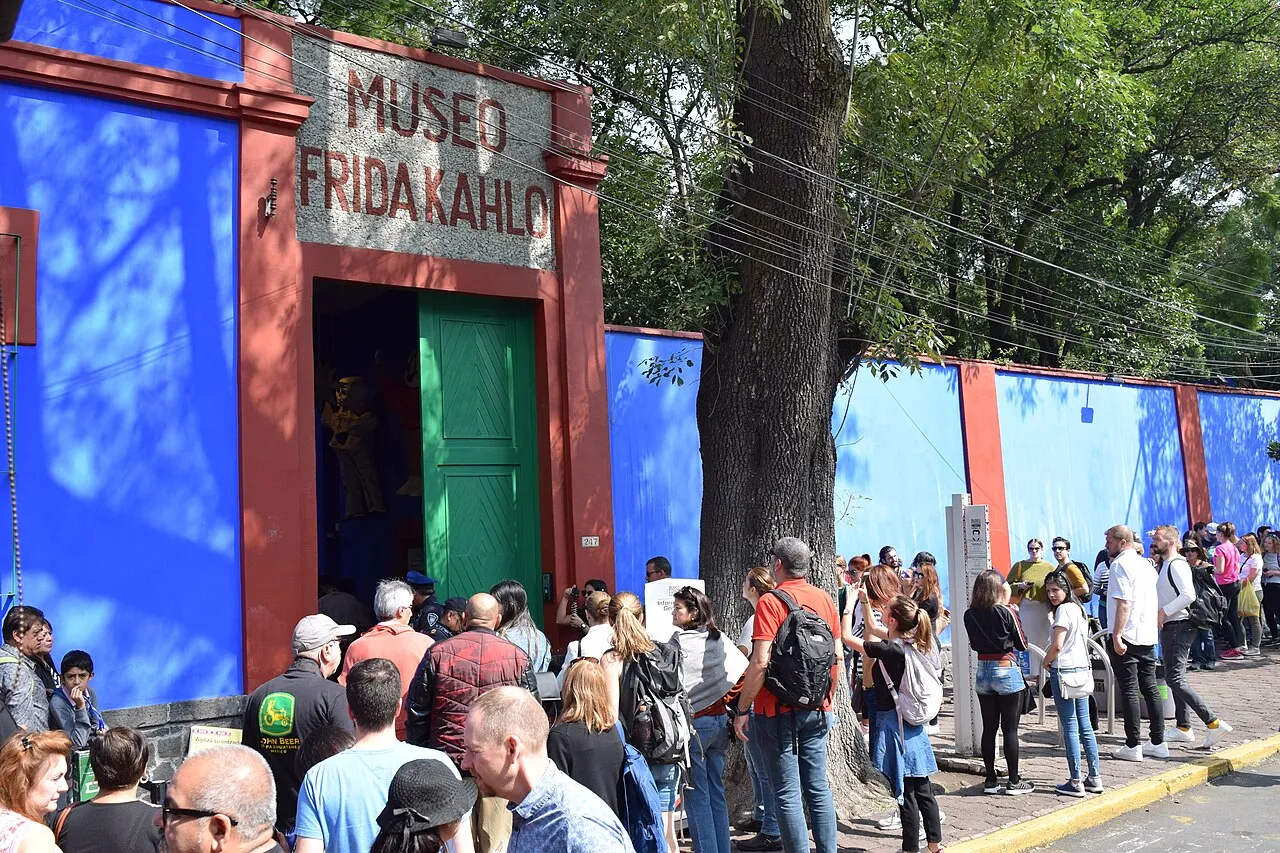
Location: The Corner of Londres and Allende, Frida Kahlo Museum (The Blue House).
The house is more than a century old. Guillermo Kahlo built it in nineteen oh four, on the corner of Londres and Allende streets. He was a photographer born in Germany who had come to Mexico in eighteen ninety. He built a house of its time, with a courtyard at the center and the rooms around it, in the style of the second half of the nineteenth century. Today it has about eight hundred square meters of built space, on a lot of one thousand two hundred.
Frida was born here on July sixth, nineteen oh seven. She used to say she had been born in nineteen ten, the year the Mexican Revolution began, because she wanted to see herself as a daughter of that era. At the age of six she fell ill with polio, and the illness left her right leg thinner and shorter. After the bus accident of nineteen twenty-five, she came back to this house to recover. Of her forty-seven years of life, she lived thirty-six here.
The property came close to being lost. In the early nineteen thirties, Diego Rivera paid the mortgages and debts that Guillermo Kahlo had left behind, and so he rescued the house.
In nineteen thirty-seven, Leon Trotsky, a Russian revolutionary fleeing from Stalin, came to live here with his wife, Natalia Sedova. To protect them, some walls were closed off with brick and the neighboring lot was bought, measuring one thousand and forty square meters. The garden you see today was planted there. The Trotskys lived in the house until nineteen thirty-nine.
Blue is the first thing anyone notices. The poet Carlos Pellicer, a friend of Frida and Diego, wrote in November of nineteen fifty-five that the house was painted blue, outside and in, and that it seemed to hold a little piece of sky.
When Frida died, in nineteen fifty-four, Diego wanted the house to become a museum for all Mexicans. In nineteen fifty-seven he created a trust with the Bank of Mexico to look after it, and he asked Pellicer to prepare the museography. The Blue House opened to the public in nineteen fifty-eight, four years after Frida’s death.
The visit takes you through the house from the inside, as a journey through a life: the painting halls, the studio and the bedrooms, and the hall where part of Frida’s wardrobe is displayed. Depending on the route you choose, you will also pass through the dining room, the kitchen and the garden. Diego commissioned the studio in nineteen forty-six from the architect Juan O’Gorman.
As you enter, on a blue wall you will see a niche with an inscription. It says that Frida and Diego lived in this house from nineteen twenty-nine to nineteen fifty-four. Below it there are small pre-Hispanic sculptures. It is one of the first things you will see as you cross the entrance, and it sums up well what comes next.
The museum is cared for today by the Diego Rivera and Frida Kahlo Museums Trust, of the Bank of Mexico. Carlos Pellicer was its first director.
Before going in, look at the corner, the color and the great door. Every room that follows holds a part of the story you have just heard.
Listen to the full audio guide for Frida Kahlo Museum (The Blue House)
72-hour pass for US$10, no subscription.