National Museum of Anthropology
Tláloc Monolith
The rain god who arrived in the city with a storm.
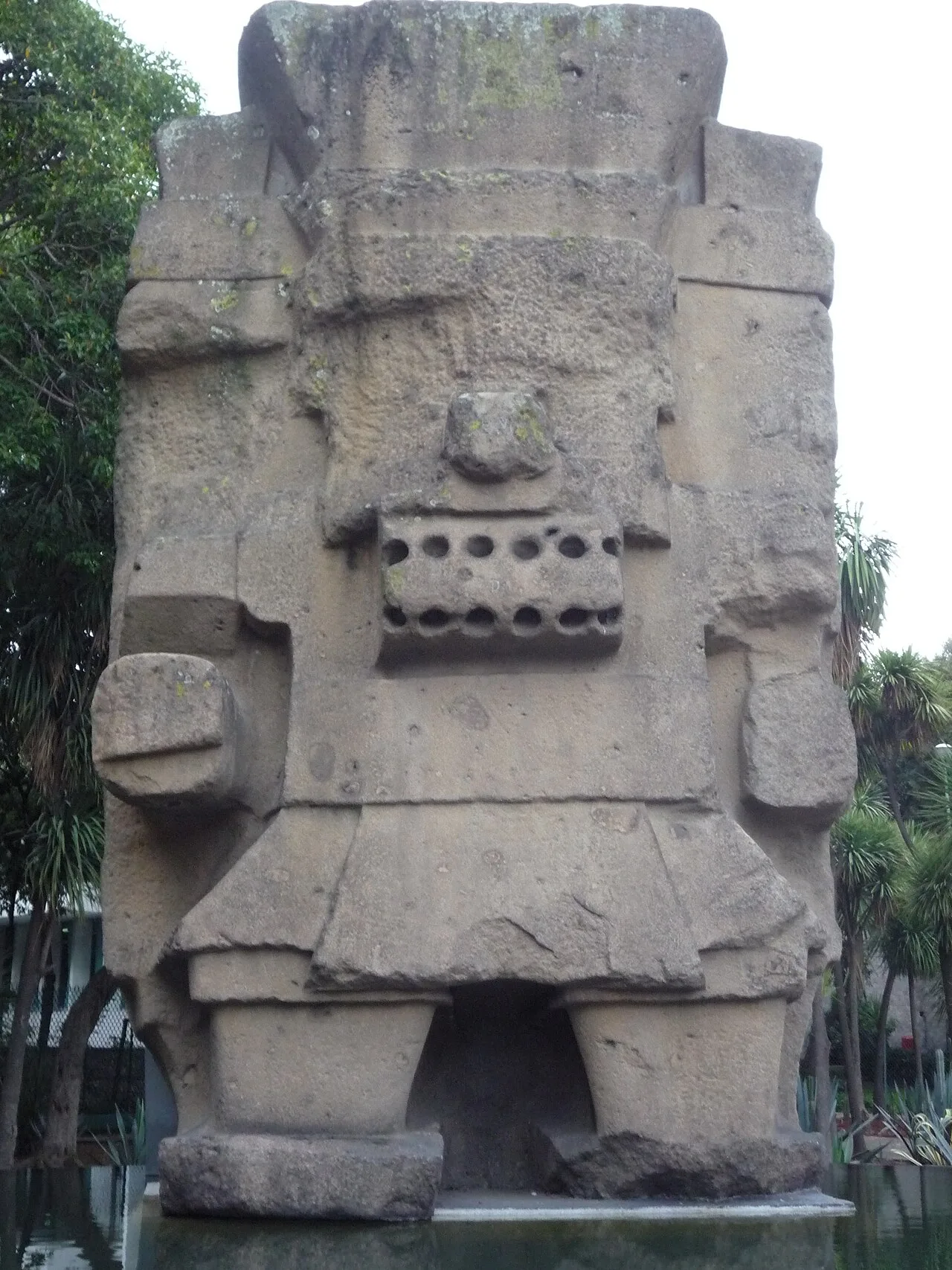
Location: Architecture and Central Courtyard, National Museum of Anthropology.
When you finish looking at it, ask yourself an uncomfortable question: is it really Tláloc? That is how all of Mexico knows it, but today several specialists think this figure could be Chalchiuhtlicue, “she of the jade skirt,” goddess of rivers and lakes and companion of the rain god. The stone carries no inscription, its style is geometric and unadorned, and it is usually attributed to the era of Teotihuacán. What is certain is what it meant: water, and therefore maize, and therefore life.
They understood that very well in Coatlinchan, the town beside which it lay, with the mountains at its back and the ancient Lake Texcoco in view. The farmers credited it with the power to bring rain to their crops, and they called the round hollows on its chest “tecomates,” because they looked like vessels. Nobody saw it as a sculpture: it was a presence.
And that is because Tláloc was one of the oldest and most powerful deities of Mesoamerica. The Teotihuacán people were already painting him more than one thousand five hundred years ago, with round eyes and fangs, and a thousand years later the Mexica still asked him for rain on the summit of the mountain that bears his name, to the east of the valley, where they had a shrine. His job was to give water to the earth, but he could also withhold it, or send hail and lightning. He was respected and he was feared.
In the early 1960s, the architect Pedro Ramírez Vázquez and the Secretary of Education, Jaime Torres Bodet, decided that the most monumental piece that could possibly be moved had to welcome visitors to the new museum. Convincing the town was not easy. In exchange, public works for the community were promised, among them a school, and even so the farewell was full of tears: the villagers saw something more than a rock leaving.
Moving one hundred sixty-eight metric tons, the weight of about twenty-five large elephants, forced people to invent logistics. It took a special trailer with many wheels, reinforced roads and bridges, and a military escort. The journey began on April 16, 1964 and was slow, heading toward a city that awaited it with curiosity. And here comes the part that no book can guarantee, but that older residents of the capital tell with complete certainty: when the stone entered the city, it rained, and it rained a great deal. There were floods in several neighborhoods. In popular memory, it was Tláloc greeting his new home.
Now look at the details. On the square headdress there are fine lines, and the eyes have those rings that, in Mesoamerican art, identify the god of the rains. The hollows on the chest perhaps served to hold offerings or to collect rainwater; nobody knows for certain.
Keep this face in mind, because inside you will meet it again. In the Teotihuacán Hall, a mural shows a deity who pours out rain over a green paradise, and a three-meter Chalchiuhtlicue bears an unmistakable family resemblance to this giant. And in the Mexica Hall you will see that Tláloc shared the summit of the Templo Mayor with Huitzilopochtli: two gods, one temple, because without sun there is no harvest, but without rain there is none either.
Listen to the full audio guide for National Museum of Anthropology
72-hour pass for US$7, no subscription.