Historic Centre of Mexico City
Palacio de Bellas Artes: The Theater That Took Thirty Years
It was designed for the Centennial of nineteen ten and did not open until nineteen thirty-four, with a different style inside.
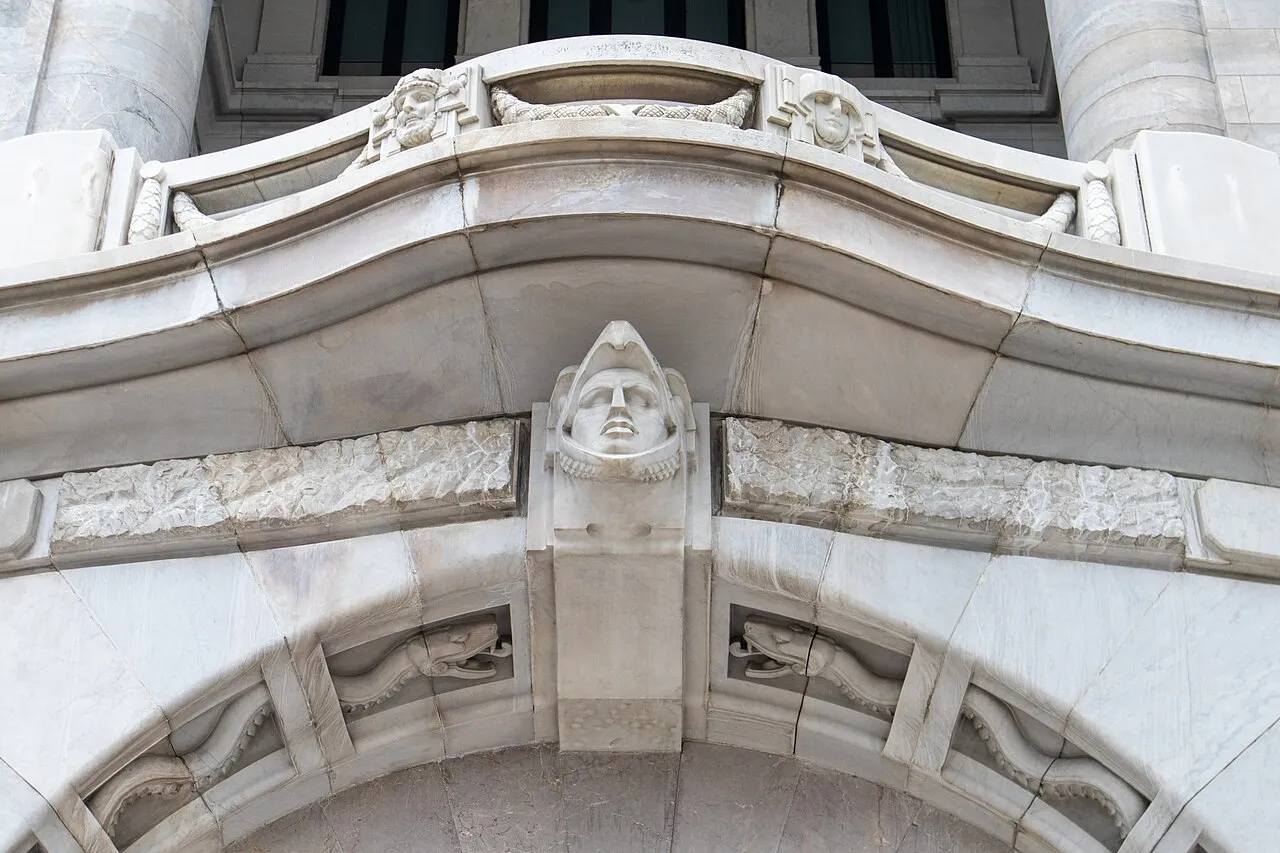
Location: Bellas Artes and the Alameda, Historic Centre of Mexico City.
Before this palace existed, there was a convent here. In the viceregal period, the convent of Santa Isabel stood on this site. After the disentailment of Church property, the convent was turned into private homes, and the church into a silk factory. Years later, the engineer Gonzalo Garita proposed that plot of land for building the new theater.
The project was entrusted to the Italian architect Adamo Boari, hired by the government of Porfirio Díaz. Working at his side was Garita, a Mexican military engineer responsible for the structure. Together they introduced to Mexico the system known as Chicago, which combines reinforced concrete and steel. Boari imagined a great glass greenhouse, crowned by three translucent domes, with ornamentation in the Art Nouveau style. Construction began in nineteen oh four. The goal was to open in time for the Centennial of Independence, in nineteen ten.
But the ground of Mexico City is that of an ancient lake, and the building was sinking. In nineteen twenty-eight, the sunken part of the base had to be dug out. Then came the Revolution. Between nineteen thirteen and nineteen thirty-two there were several attempts to finish the work. Boari left the country and never saw his theater completed.
In nineteen thirty, Federico Mariscal presented his definitive project. Work resumed in July of nineteen thirty-two, and construction was completed in March of nineteen thirty-four. Mariscal kept Boari’s exterior and designed the interior in the Art Deco style, with geometric forms and elements that evoke the pre-Hispanic world. For those interiors, marbles from different regions of Mexico were used.
The inauguration took place on September twenty-ninth, nineteen thirty-four, with President Abelardo L. Rodríguez. At the gala performance, the audience heard the Orquesta Sinfónica de México, conducted by Carlos Chávez, and watched a staging of La verdad sospechosa, by Juan Ruiz de Alarcón. What had been born as a tribute from the Porfiriato to the Centennial was finally opening in a postrevolutionary Mexico. The palace also included a museum of visual arts, which opened two months later. We will talk about it at the next stop.
The four Pegasuses on the esplanade are the work of the Spanish sculptor Agustí Querol. They arrived from Spain in nineteen eleven and were meant to crown the corners of the theater’s roof. After several moves, including a stay in the Zócalo, they ended up here. Pegasus is the winged horse of Greek mythology and is associated with imagination and creativity.
There is one piece that cannot be seen from the street and that appears only at certain performances. It is the glass curtain of the auditorium, designed by the stage designer Harry Stoner and made by the Tiffany company of New York. The contract was signed in nineteen oh nine, and the curtain was installed in nineteen twelve. It is made up of nearly a million pieces of opalescent glass, weighs more than twenty tons and depicts the volcanoes Popocatépetl and Iztaccíhuatl.
And there is one fact that surprises. The Palacio Postal, which Boari and Garita built before this theater, still stands without showing any sinking. We will visit it later on. For now, turn toward the Alameda, because this esplanade is only the beginning.
Listen to the full audio guide for Historic Centre of Mexico City
72-hour pass for US$7, no subscription.